Sasha Ohayon
Born in London, England, to Moroccan and Lithuanian parents, I've been enthralled by my surroundings and innately curious since I could crawl — constantly trying to understand the world around me. I was always interested in science and maths, reading the children's encyclopedia as nightly reading material to learn about volcanoes, atoms, biology, and anything else I could. That eventually morphed into an interest in building things, which led to my education and career in engineering.
I'm a hardware engineer, passionate about my craft and set on working on the most consequential projects at the best companies. Right now I work on hardware for self-driving, infotainment, body control, and more. This includes conception, architecture, design, validation, and testing.
I've put many thousands of hours into my electrical engineering skills, and am proud of what I've accomplished in this industry and discipline so far. However, I also put significant effort into developing my cross-disciplinary engineering skills. To me, this means understanding engineering problems from a higher level, in addition to the low-level hardware design.
Ford Motor Company
Due to my work as Hardware Engineer I, I was placed on an expedited path to promotion. After this promotion, I was tasked with leading feature feasibility and cost consolidation initiatives for future vehicle platforms, architecting next-gen hardware concepts and driving schematic capture and BOM generation. Eventually, several of these investigations were moved into committed projects, including an in-house body control module with integrated gateway - a first for Ford - and an in-house infotainment module with integrated tuner and audio amplifiers. I am now leading both these modules. I own the main compute (MCU) on the BCM, which includes pinmuxing, high-speed constraints, PCB layout, and more. I also own the main compute on the infotainment (SoC), as well as the tuner. Both of which I'm implementing at the schematic level as well as the layout. I will later conduct WCCAs for related circuits and build test plans for preliminary builds.
Highlights
- Led four engineers in the schematic design of a ~1,500-part, 10-layer PCB for a body control module consolidating domain control, gateway, and vehicle access into Ford's first in-house implementation, cutting over $75 per vehicle.
- Co-architected and directed schematic and layout for a ~5,000-part, 14-layer PCB for an L2++/L3 ADAS module, defining peripheral and compute partitioning across two boards and composing dual ASIL-B compute modules with independent supplies into a high-integrity ASIL-D architecture.
- Across both PCBAs, I successfully constrained, simulated and routed PCIe, LPDDR5X, NVMe, UFS, Ethernet, MIPI and CAN interfaces using Xpedition and SiWave.
- Drove multi-vendor silicon selection across AI SoC and MCU platforms, benchmarking compute, IO, power, and cost; used Python to build an ONNX compute proxy standing in for in-house models to characterize workloads and size compute for L2 through L3 ADAS.
Shortly after joining Ford, I was tasked with the development of a 12-layer in-house L2 ADAS PCBA with dozens of high speed interfaces. Since the team was new, I was one of the only members, and so I tackled that task completely independently, which was out of the ordinary for someone of my tenure. I delivered three successful builds of this board with no hardware errors. I took multiple trips to the build site to oversee assembly and verify that the board worked through boundary scan and other tests. I later developed test plans for specific sub circuits that were altered significantly from the reference design, including camera circuits. This module was later unfortunately cancelled, which halted my development, but my learnings were huge and I carried those with me to the development of several more boards.
Highlights
- Delivered a 3,000-part L2 ADAS PCB refactor as sole schematic owner, adding a high-density connector, redrivers, and sub-circuits enabling additional PCIe and MIPI connectivity while removing 15% of board area to support coolant tubes.
- Completed two full schematic and layout cycles through successful engineering validation builds, supporting on-site bring-up and flash verification in Mexico ahead of line start, followed by in-house design validation including eye diagram capture and high-speed interface characterization.
- Presented architecture recommendations to senior management spanning cost and engineering impact, now being adopted across several next-generation vehicle programs, including ADAS, infotainment, and domain control.
Skydio, Inc.
Highlights
- Routed multiple USB and MIPI C-PHY interfaces on a dense 4-layer PCB using only through-hole vias, achieving the required density without ELIC or added layers, and used backdrilling to eliminate via stubs.
- Developed and executed validation test procedures for PCM lockout, battery fuel gauge, and charging circuits across prototype builds.
- Owned board outline, placement, and connector strategy for multiple PCBs on a consumer product, working against industrial design and mechanical packaging constraints.
Magic Leap, Inc
Highlights
- Increased LED brightness resolution by 6× on an AR headset display by implementing PWM shunt-FET dimming, enabling luminance below the previous hardware floor while reducing power draw at equivalent brightness.
- Reduced switching transient times by ~100× through pull-up optimization and a gate voltage divider, raising maximum usable PWM frequency from kilohertz toward the megahertz range required by system timing.
- Built an automated microcontroller-based test setup using hardware interrupts synchronized to display enable signals, cutting test script runtime 80% and replacing a function-generator rig with limited customization.
Vitalsines, Inc.
Highlights
- Designed multiple circuit schematics and PCB layouts in a short time to produce a commercial grade vibroacoustic signal acquisition system projected for use by thousands of patients.
- Designed in SolidWorks and 3D printed enclosures for PCBs of my own design, with panel mount connectors to support board-to-board connections.
- Bench tested ECG, piezoelectric, piezoresistive and flex sensors and interfaced them with an Arduino using MATLAB to evaluate their suitability for collecting vibroacoustic data
Muse AI Charm
Building custom PCBs and software to develop my own Meta Muse Charm using ESP32 Oct 2026 - present
Working on schematics for a custom ESP32-based board for the purpose of developing my own AI charm. Plan is to implement MEMS microphones, WiFi, BLE, thermal, cameras, and more.
Jetson Nano Smart Home
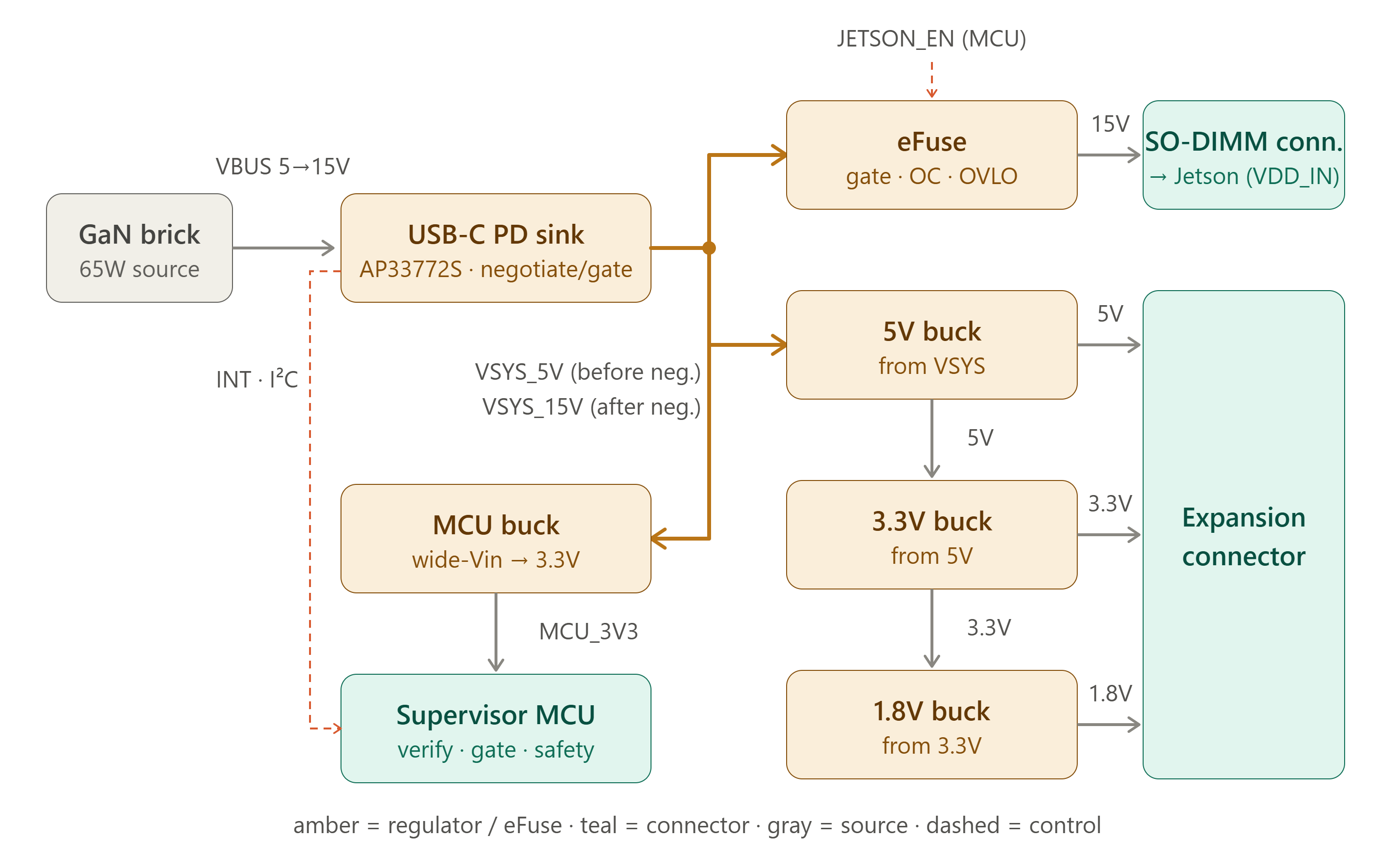
Building custom PCBs and software for a Jetson Nano based AI assistant July 2026 - present
Working on schematics for a custom Jetson Nano carrier board for the purpose of adding peripherals and customizing the form factor of a Jetson Nano. Planning to implement the Jetson Nano into a larger, more informed AI-based smart home assistant. Currently implementing schematic with high speed connectivity, MEMS microphone array, USB power delivery, thermal camera support, and plans for mmWave and other technologies. The project is still in an early phase but I'm beginning schematic work now after playing around with the Jetson for a few weeks hosting open source smart home software and using Ollama to host local AI models.
Schematics & images
Battery Replacement Drone
Mechatronics Engineering Capstone Project September 2022 - April 2023
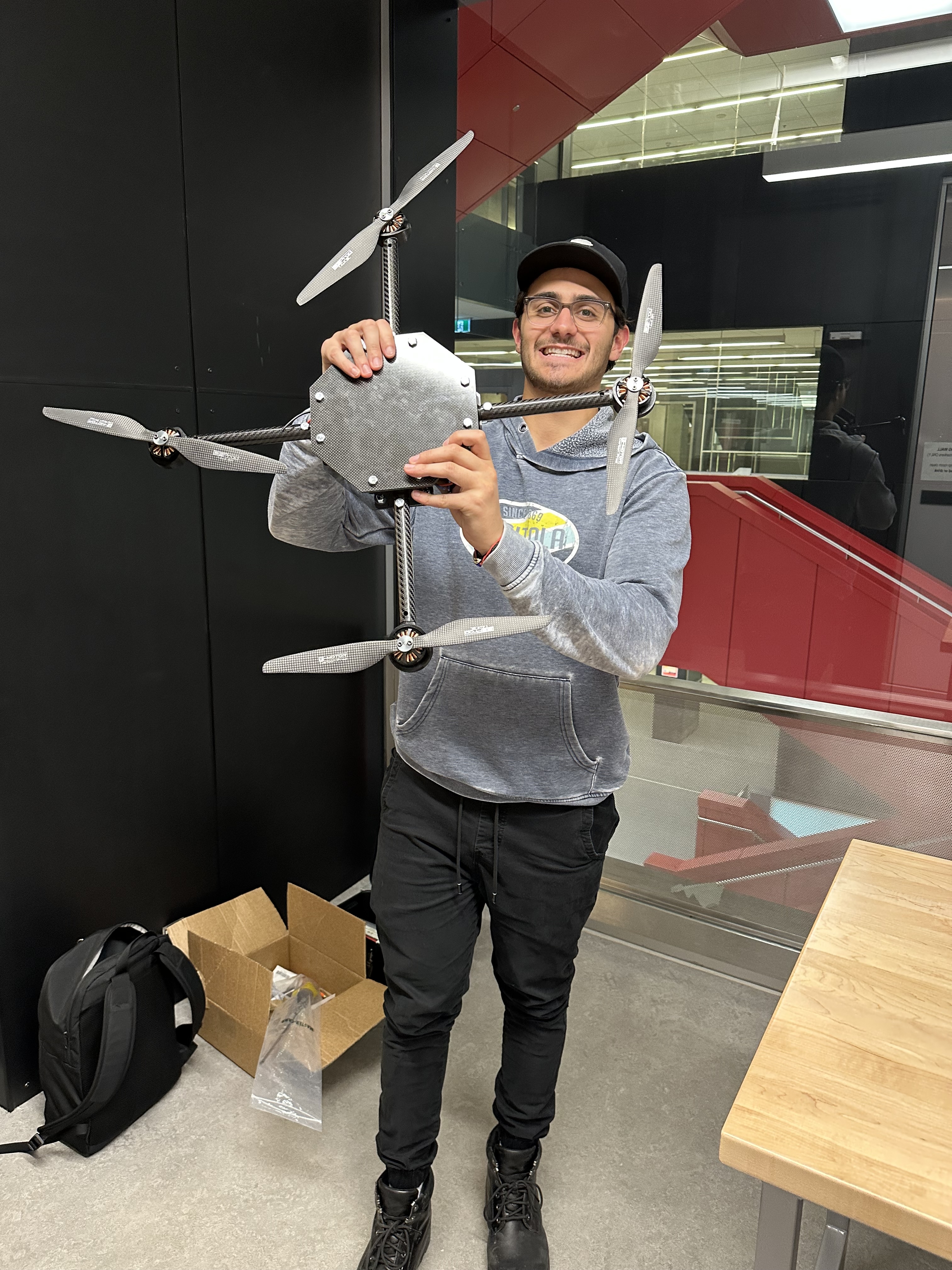
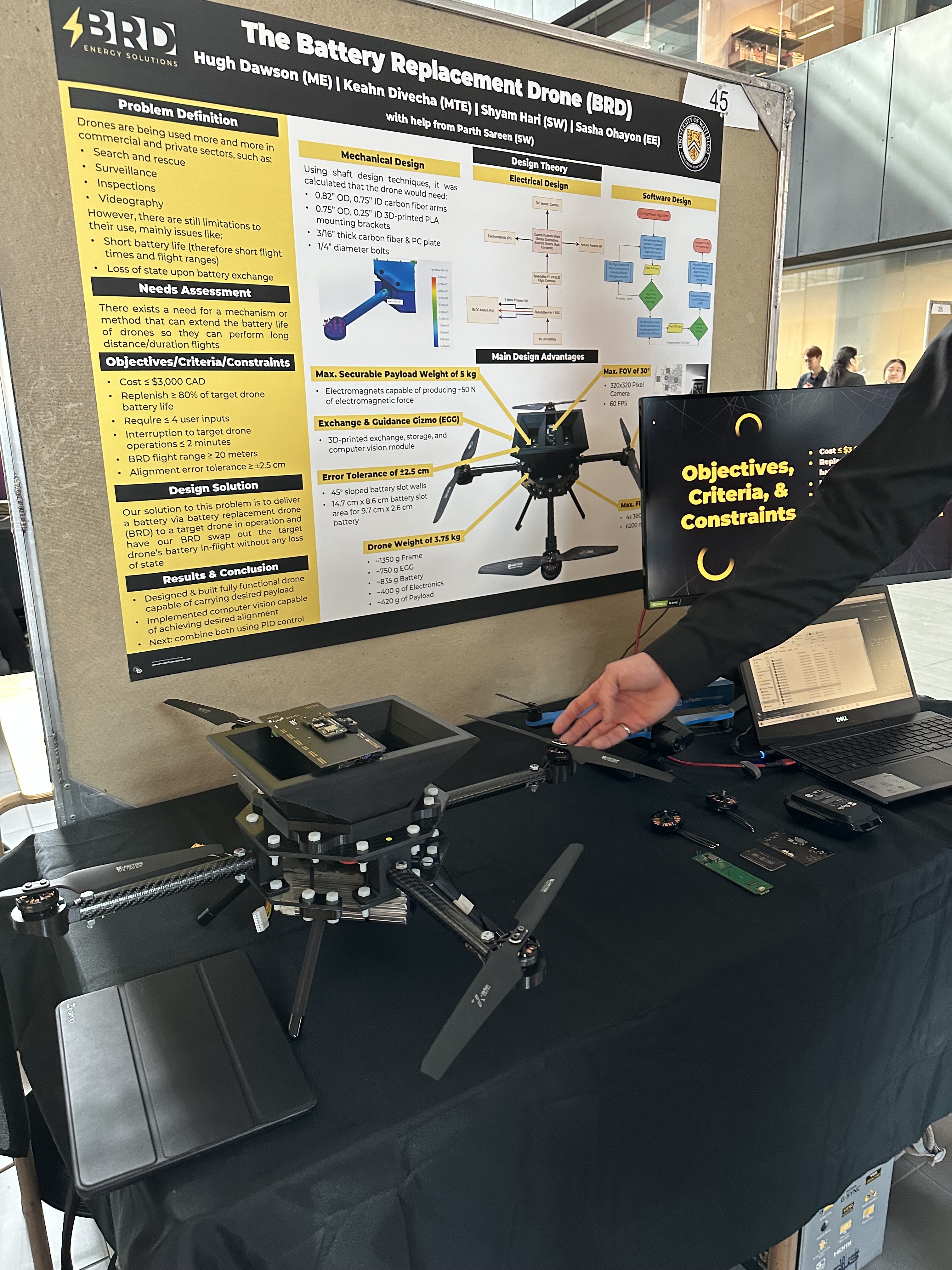
The battery limitation of drones is a major obstacle to achieving continuous flight time which is a significant issue for a number of fields such as drone delivery, building scanning, and surveillance. There is a clear need in the market for a mechanism or method to extend the battery life of a drone to perform long duration flights. My Capstone Project team decided to tackle this problem by developing an idea for replacing a drone's battery mid-flight using another drone.
Highlights
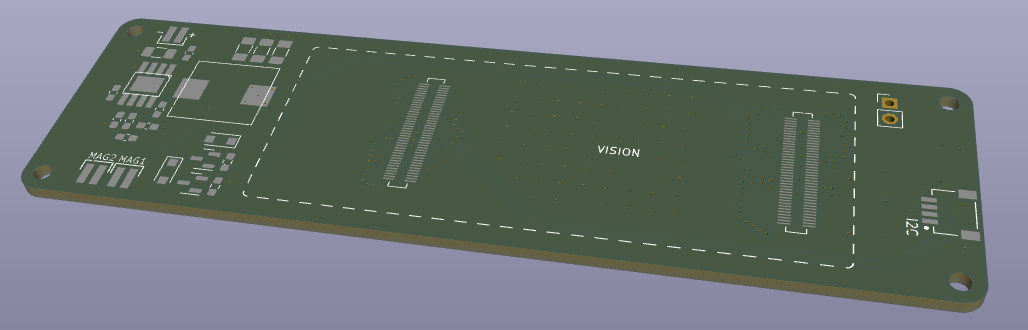
- Designed an 8 layer PCB with microvias for the purpose of interfacing an Arduino Portenta X7 with external peripherals and sensors. This included a camera and TOF sensor. Integrated a buck converter into the PCB to regulate a 6S Li-Po battery down to 5V.
- Derived motor specifications from mechanical requirements such as mass and thrust to mass ratio.
Schematics & images
Files
Indiana University
Master of Business Administration, Interdisciplinary Engineering 2025–2027 · GPA 3.9
As engineers, sometimes we want to put our heads down and get to work on the nitty gritty. The concepts, the architecture, the design, the testing. We often forget that the products we build must not only be capable but also be practical, meet a market need, and be profitable. My experience at Indiana University so far has been highly complementary to my engineering background and has helped me to see the company vision from a new perspective, other than only an engineering one.
Purdue University
Master of Science, Interdisciplinary Engineering 2024–2026 · GPA 3.91
I joined Purdue University in 2024 as a part-time student. I've been simultaneously working full-time and balancing the two has certainly been a challenge. I enrolled in a double degree - a combined MBA and MSE - because I value higher level business skills that play a role in our day to day lives as engineers. In the engineering portion of my degree I took courses like Semiconductor Memory Technologies and Applications, Hardware for Machine Learning, Datacenters and Cloud Networks, Hybrid Electric Vehicles and more. Through these courses I was given the opportunity to learn a lot about how memory technologies and semiconductors work in the context of today's AI compute frenzy. I was able to design a 10T SRAM cell in Virtuoso and overall brought these learnings with me back to my employer, where I applied them to my work on SoC characterization and memory bandwidth studies.
University of Waterloo
Bachelor of Applied Science, Mechatronics Engineering 2018–2023 · GPA 3.7
Joined the University of Waterloo in 2018 in their highly selective Mechatronics Engineering program. My first two years, I took a slew of engineering courses related to electrical engineering, mechanical engineering, and software engineering. Throughout my time at the University of Waterloo I was required to completed 5 internships to graduate. My early internships were hardware adjacent and I used those to break into the hardware space. Eventually, through a ton of hard work, projects, networking and perseverance, I was able to get my first electrical engineering roles at Vitalsines, Magic Leap and Skydio. Coursework-wise I was beginning to focus exclusively on electrical engineering in my final two years. Taking courses like Analog/Digital Electronics, Power Electronics & Motor Drives, and Radio and Wireless Systems.
Portfolio
I run a concentrated active investment portfolio built around my convictions. My portfolio is a manifestation of my worldview and opinions and is thus heavily concentrated in technology. To me, durable outperformance comes from owning businesses whose moats are built on strong intellectual property. I'm not usually interested in advantages you can replicate with a big enough balance sheet. I want moats made of patents, standards, ecosystems, and switching costs. I've sold businesses I consider world-class purely because their edge came from capital intensity rather than IP. It's a line I hold even when the business is great, because those moats erode in ways an IP moat doesn't. My positions are usually valued by comparing forward P/E to its industry average. I will also look at trailing P/E and EPS and revenue growth year over year. This all, of course, plays into a larger thesis regarding the position that is always the driving motivating factor for a new position. Forward P/E can mean less in the situation where a company is less likely to materialize those earnings. These numbers only mean so much. Companies are not just financial instruments defined by their tickers and PE ratios. They are entities with complex management structures, philosophies, worldviews, and balance sheets. I try to look at my investments through that lense. The portfolio is weighted approximately by a combination of market cap and conviction. I also use my own sector categorizations to thematically break down my portfolio and understand my concentration. AMZN and WMT being the same GICS label just urks me. I target a mid-to-high-teens forward CAGR and roughly 750 bps of annual alpha over QQQ. When a thesis stays intact through a drawdown, I add rather than trim. Selling is reserved for broken theses and philosophical violations. I also target outperformance by means of increased beta during uptrends and conservative drawdowns. On the liberation day tariff shock, my portfolio was down 19.83% YTD, while NDX was down 20.79%. However, by the end of the year my portfolio was up 44.04% while NDX finished the year up 21.14%. This trend has continued into 2026, where my YTD low was -3.1% on March 30th, while NDX was down 10.4% YTD. As of August 24th, my uptrends have been stronger than the benchmark, where my portfolio is up 29.68% and NDX is up only 12.2%. I rarely ever purchase options, and usually only to take a short position.
Percentages of my overall portfolio — a personal record, not investment advice. I add to these positions with regular contributions.
% of portfolio
Holdings as of Oct 7, 2026
Journal
October 12, 2026
I wanted to talk about some of my specific holdings, and the overall portfolio construction again. There is more to it than I initially let on, since I just didn't have time to write. Starting with NVIDIA. NVIDIA is hardly a controversial pick, but some might think my weighting is a little excessive. I'll admit it only got this high because NVIDIA has been priced so reasonably for so long. I have been accumulating shares around the $200 mark, whenever the forward P/E is around or below 30. 30 times earnings for a tech giant like NVIDIA is a fair price to me and to me, it is close to guaranteed that they realize at least another two years of projected revenue numbers while still managing to beat. Currently, price is at $225 with P/E of 29 and forward P/E of 24.5. This implies projected growth of 18% while being priced around the same premium as companies like Microsoft and Amazon. My thesis for NVIDIA is centered around their incredibly powerful IP MOAT. Its almost guaranteed that we will see a slowdown of the datacenter buildout as we approach the end of the decade, and NVIDIAs growth will slow. However, I think that this slowdown is unlikely to create a downside to current prices. We still have several years of double digit growth. If earnings grow 50% over the next 3 years, and in 3 years the growth projection is 10%; if we assume P/E multiple of 20, this means a stock price about 10% higher than now. This to me is a more neutral-leaning bearish case. NVIDIA has its hands deep within the autonomy world, and while the company will eventually lose its datacenter growth engine, it will certainly capture significant portions of the robotics and autonomous vehicle markets, which are growing rapidly. NVIDIA is investing in chip architectures that are catering to markets that barely exists yet, and has the tools to entice customers to adopt. There will be competitors, but its nearly impossible to catch up. From the automotive perspective, its pretty clear that they and QCOM are miles ahead of the game.
October 7, 2026
Just an update - haven't rebalance in a while, as there is no real reason for me to do so. Overall performing well. META, NVDA, AVGO been doing well recently.
August 28, 2026
Given that this site is new and my portfolio has existed for a few years, I wanted to break down some of my holdings and the high-level thesis. I'll start from bottom up. SMR - I'm a firm believer in the adoption of nuclear. It's incredibly clean and has a very low physical footprint. The cost associated with nuclear power plants is usually due to build costs and inefficiencies in construction, which delays the projects. SMR looks to change this through small modular reactors. Building small reactors that are replicable and can be dropped at the site of a datacenter and fuel the whole thing, is in national interest. Overall, this is my smallest position, because it is highly speculative but the price is more reasonable than its peers. Furthermore, it looks to license its designs rather than operate physical infrastructure, which I love. CRSP - World changing technology at a reasonable price. Still speculative but is working in real life human trials, once this is commercialized, it will change the medical world forever. Also, it trades at under a 6 billion dollar valuation while possessing over 2 billion in net assets. RKLB - A bit of an emotional hold for me, while I think its objectively overvalued, Peter Beck is fantastic and I believe in his ability to continue to surprise me and execute. He is targetting new markets and I think the upside is huge. MDA - Playing further on the space theme. Proven management with long term track record. I think that space exploration is positioned to expand significantly and this is one of the few fairly priced names. NFLX - Punished for a reason that I don't really resonate with. Prior to the Warner Bros. deal, they were trading at a 35% to 50% higher price, while having lower TTM earnings and lower guidance. To me, the Warner Bros. deal indicated that the managment is fiscally responsible and was not willing to overpay for an asset. It was an absolute win. NTDOY - Nintendo is a diversifying, lower risk play for myself. Trading at a low relative valuation while being positioned to profit from strengthening IP due to a multitude of successful movies. They are underpricing their own software services compared to the competition and has room to increase pricing. Ocarina of Time remake will also drive many long term gamers like myself to buy the Nintendo Switch 2, which is the best selling Nintendo in history, but simultaneously, anecdotally, I know nobody who has one. QCOM - Getting more interesting. QCOM is priced as if they never sold a single AI chip. QCOM has incredibly strong leadership and is positioned as the AMD to NVIDIAs automotive business, but I would argue they are more competitive than AMD. Incredibly strong products and great execution. The AI business is pure upside. AVGO - I bought this one when forward price to earnings was around 30. It only happens for brief moments before earnings, but this company is positioned to dominate as we see GOOG, AMZN, META, OpenAI, Anthropic and many more moving towards custom chips for inference workloads at scale. PLTR - Finally, this company came back down to earth. Was trading at hundreds of times earnings and way above its intrinsic DCF valuation. It now trades around its IV and its forward price to earnings versus its price makes it feel more reasonable. Bought this around $130 in the last two months. MA - Self explanatory duopoly, to me is bullet proof, despite alternative payment options appearing. They are undervalued based on historical trends. I'm up 20% on this since late last year. I'll do another post for the last four. AAPL, META, GOOG, NVDA.
August 26, 2026
Looks like the market reacted positively to NVIDIA's earnings. I would be surprised otherwise, although I have been surprised before. NVIDIA's growth is accelerating, and most of the negative price action has been associated with overall AI fear, which to me is not a write off, but will not pose enough of a risk to NVIDIA to prevent myself from investing.
August 25, 2026
It's been a while since I've done any rebalancing, but with this new website I wanted to provide an initial update. Tomorrow are the NVIDIA earnings, at the time of writing this, NVDA is my largest position, at 17.12%. I've opened positions between $90 and $190 per share, depending on the relative valuation of the company and the amount of available cash in my account. I am highly bullish on NVDA although generally the market expectations are sky-high and they are punished after earnings. I think this this time may be different, NVIDIA is trading at a really low valuation relative to its historical average and its peers, while maintaining massive growth and robust products that are ahead of the competition in terms of foresight into emerging AI HW trends. Software is one of NVIDIAs moats. Through CUDA they are near bulletproof. AMD has tried to build conversion tools, but to little avail. Regardless, I'm interested to see how the market reacts to this news.